The differences
between natural and engineered stone

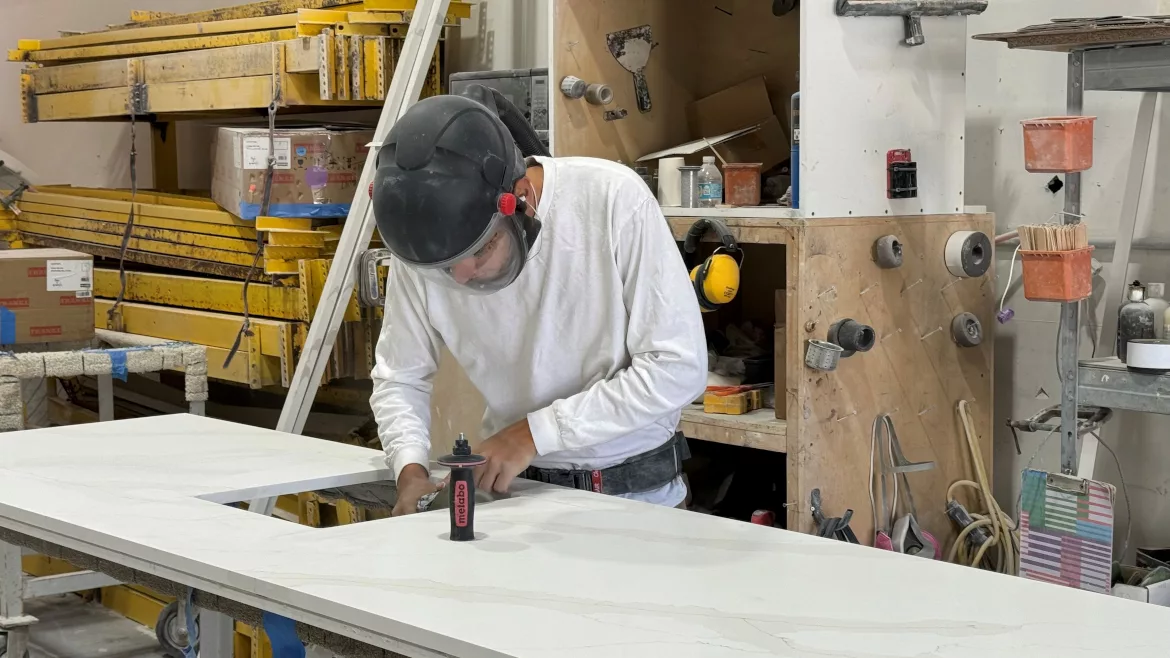
Addressing fabricators at StonExpo East in Atlanta, GA, Duane Naquin of Stone Interiors and Jessica Rose of G&L Marble, Inc. explained the differences between natural and engineered stone.
In the seminar “Working with Engineered and Natural Stone Countertops,” which was held during StonExpo East in Atlanta, GA, earlier this year, Duane Naquin of Stone Interiors and Jessica Rose of G&L Marble, Inc. provided facts on the pros and cons of each material as well as diminishing any myths about each. They spoke to a full room of fabricators, who listened intently and asked questions.
The seminar began with an explanation of the geological composition of each material - explaining that granite is actually a combination of quartz, mica and feldspar. “[A total of] 90% of what you sell is not really granite,” said Naquin. “There is a difference between the geological name of granite and the commercial name. If it has movement and veining, it’s not granite. It’s just something to be aware of. What we are really selling is the performance.”
Naquin went on to explain that engineered stone is 93% quartz, based on weight; the rest is a mix of resin, glass, dyes, etc. “It starts off as a powdered mix and is pressed into [slabs],” he said, adding that while there are several brand names of engineered stone on the market today, most are generally made using the same Breton machinery. Additionally, he said the same colors of quartz crystals are used in all brands, and the different shades of material are actually achieved through dyes.
According to Naquin, “engineered marble” is also available with characteristics similar to natural marble. “They are going to do all the things that natural marble does,” he said. “It will etch.”
Cleaning issues
During the seminar, the myth that granite harbors bacteria was addressed. “You do get customers that believe this,” said Naquin. “Bacteria needs a food source. It can’t eat granite. If you are going to be a messy housekeeper and leave food out on the counter, you’ll get bacteria no matter what type of countertop you have.”Naquin went on to explain that many tests have been conducted over the years to prove the cleanability of granite. In particular, there was a test that was performed by the Hospitality Institute of Technology and Management. “The first cleaning was done with soap and water,” said Naquin. “Granite had the biggest reduction in germs. In terms of cleanability, granite is very good. It’s very dense.”
Sealing
Another point of interest during the presentation was the topic of sealing. “Does granite need to be sealed?” asked Naquin. “It depends on who you talk to. The nice thing about engineered stone is that they all perform the same no matter what the color. Granites vary.”Naquin explained that engineered stone has a typical absorption rate of 0.05%, while the absorption in granite varies between 0.01 to .40%. White body ceramic absorbs 3%. “You never hear anyone saying that porcelain or ceramic needs to be sealed,” he said. “Relatively speaking, granite is very good in terms of porosity.”
A sealer is used to penetrate a stone and reduce its porosity, said Naquin. “Does it bring it down to zero?” he asked. “No. The only way to totally prevent anything getting in is using a topical sealer, but we don’t do that because it will change the color.”
He went on to say that at Stone Interiors, they seal everything. “We also seal every piece of engineered stone that leaves the shop,” he said, adding that he “did some highly unscientific but practical testing.” Naquin explained that he took two pieces each of a light- and dark-colored granite and engineered stone - one piece of each was sealed and one was not. “I went to our office kitchen and put everything imaginable on them - ketchup, mustard, etc.,” he said. “I let it sit in my office for a week. The dark unsealed granite and engineered stone was fine, but I had to scrape off the stuff. The sealed versions could be wiped off. After everything, only the light-colored granite was stained. After [another] week, the stain evaporated out.”
During the discussion, several participants expressed interest in knowing what cleaners to use on granite and engineered stone. One fabricator specifically asked whether to recommend professional stone cleaners or soap and water to the homeowners.
“I always recommend a professional stone cleaner,” said Naquin. “For example, Absolute Black has calcium in it. If a citrus cleaner is used, it will bring out that calcium. So we always give cleaning suggestions [to our customers]. I recommend cleaners that go along with the sealers that were used. Products like Windex, 409, etc. can lead to build-up or film on stone.”
Color matching
Additionally, the issue of color matching was also addressed. While it is a known fact that granite is a natural material and therefore has color variation and veining, Naquin and Rose pointed out that there is some color variation with engineered stone as well.“It’s better than granite, but not a perfect product,” said Naquin. “You have to make your customers aware that it is not perfect. Between lots, there can be a total variation.”
Temperature tolerance
Another interesting fact discussed was the temperature tolerance of both granite and engineered stone. “Granite can hold 2,000+ degrees,” said Naquin. “I tell my customers all the time that you can put a hot pot on it. I have seen where a house burned, and people went in and salvaged the granite and cleaned it.”A question was raised in the audience asking if putting a hot pot on a granite countertop would affect the sealer, and Naquin answered that it would not.
On the other hand, the resin in engineered stone melts at around 400 degrees, according to Naquin. “The problem with engineered stone is still the same that is with solid surface - cooling and expansion,” he said. “It will create blistering. You can actually set engineered stone on fire with a blow torch.”
Other issues
With regard to engineered stone, another fabricator asked if the material can be faced polished. Naquin explained that it is very difficult because of the heat factor.During the seminar, it was also mentioned that there is a difference between the gloss on granite and the gloss on engineered stone. Rose explained that engineered stone doesn’t get as high a degree of polish, and this sometimes can be disappointing to a customer. “There is definitely a visible difference in polish between the two,” she said.
On the other side, engineered stone allows for less seams than granite - although Naquin was quick to point out that there will still be some seams. “Before the invention of engineered stone, the solid surface industry promoted ‘no seams,’ “ he said. “They backed off now because engineered stone has seams. It has a greater flexural strength than granite, though. You can get a bigger piece, but it still will have seams.”
In conclusion, Naquin and Rose said that they are in favor of both granite and engineered stone. “In my opinion, both are good products,” said Naquin. “I wouldn’t sell engineered stone if I didn’t think it was a good product. It fills a void for people who really want consistency.”
Looking for a reprint of this article?
From high-res PDFs to custom plaques, order your copy today!