Stone Grandeur Beneath the Dome
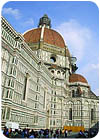
The massive dome of Florence's Duomo has made it an international icon, and it features extensive use of Italian marble from three different areas of Italy.
Photos and text by Michael Reis
As the fourth largest church in the world, the Duomo in Florence, Italy, is defined by the Filippo Brunelleschi-designed dome that sits atop the cupola. But it is also a grand display of Italian marble, with white, red and green varieties that were sourced throughout Italy.
Often referred to simply as “The Duomo,†the many components of the structure were created over the course of six centuries. The basic architecture was conceived by Arnolfo di Cambio at the end of the 13th century, and Brunelleschi's cupola and dome - completed nearly 140 years after construction first began - made it a symbol for the whole of Tuscany. Structural and decorative projects were carried out on the exterior for the next few centuries, continuing as late as the 19th century. These range from the 16th century marble flooring to the execution of the sculptures and the frescoes in the cupola. Even some unadorned sections of the marble facade were not addressed until the 19th century.
The impetus for the present-day Florence Duomo was actually the construction of new Duomos in Siena and Pisa, which were completed during the late 13th century. Envious of its rival cities, the Florentine Republic, at the suggestion of the notary Ser Mino de Cantoribus, decided to replace it with a larger and more magnificent cathedral in 1293. The republic was prepared to finance its construction “so that the industry and power of man are unable to invent or ever attempt again anything that is larger or more beautiful.†Of course, to finance such an endeavor, the general population was expected to participate in the costs, and all last wills and testaments at the time bore a tax which was then put towards the building of the Cathedral.
The project was assigned to Arnolfo di Cambio in 1294, and he ceremoniously laid the first stone on September 8, 1296. As the head architect of the City Council, di Cambio was already revolutionizing the Franciscan basilica of Santa Croce, and he also started work on the construction of Palazzo Vecchio in 1298.
One noteworthy aspect of the construction was that the new Duomo was actually built on top of the older cathedral. This was done so that Santa Reparata could remain open during construction, and for more than 70 years, Florentines entered their old church through the freestanding facade of the new one.
Orders to demolish the structure, which was slightly more than half the size of the present basilica and featured two belltowers, finally came in 1375. Considerable remains can still be seen today in the archeological area underneath the Cathedral.
Overall, di Cambio worked on the Cathedral from 1296 to 1302, the year of his death. Although the dominating style of the period was Gothic, the basilica has a more classical scale, with three wide naves that meet where the high altar stands. The planned diameter for the dome of the cupola was 150 feet, matching that of the Baptistery. Thus, Arnolfo spent the last few years of his life completing two bays and the new facade, which he only had time to complete halfway before his death.
Giotto's Belltower
The death of di Cambio was a major blow at the time, as it virtually stopped work on the project. However, when the body of St. Zanobius was discovered in Santa Reparata in 1330, the city was reawakened, and in 1334, Giotto was nominated overseer for the building site. Although Giotto himself died only four years later, he made a significant impact on The Duomo with his concept for the belltower, considered to be one of the most beautiful in Italy. Sparing no expense, Giotto created a monument that was more decorative than functional. It features a surface of three varieties of Italian marble - white marble from Carrara, green marble from Prato and red marble from Siena.The play of color comes from Giotto's experience as a painter, and although the complexity of design slowed completion of the project, it also played a critical role in its timelessness. The surface of the belltower includes a figurative “narrative†around all four sides, carried out with a series of tiles in relief by Andrea Pisano, who completed the South Doors of the Baptistery in 1336, from designs that were carried out in part by Giotto himself. These tiles are surrounded by the red marble from Siena.
Upon Giotto's death, Pisano took over the assignment for the next decade and was replaced by Francesco Talenti in 1348. Ultimately, it was Talenti who completed the tower in 1359 and delivered it to the city in its present form, making only a few changes to Giotto's original project. The slender structure measures 278 feet high and only 47 feet wide. It was built on a square plan and is supported by polygonal pilaster-shaped buttresses at the corners that continue to the top. These vertical movements are crossed by definitive horizontal lines that give the belltower a height of five stories. They also provided a continuity to the construction that allowed it to successfully pass through the hands of three different artists.
Work Progresses
As work on the project continued, this combination of all three Italian marbles continued - particularly the white from Carrara and the green from Prato - and it defines the tone of the building to this day.In 1412, The Duomo was given the name, “Santa Maria del Fiore†(Holy Mary of the Flower), which refers to the lily as the symbol of Florence. Construction of the external marble continued as well as the decorations around the side entrances. Work on the cupola and Brunelleschi's dome took place during this period, and the cathedral of Florence was consecrated by Pope Eugene IV on March 25, 1436.
At the base of the dome, just above the drum, Baccio d'Agnolo began adding a balcony in 1507. However, after one of the eight sides was finished in 1515, Michelangelo harshly criticized the work, saying “It looks like a cricket cage.†Given Michelangelo's irrefutable stature, work was immediately stopped, and to this day the other seven sides remain rough brick.
Amazingly, the facade that is in place today did not receive its final touches until the years between 1871 and 1887. The facade features a neo-Gothic composite designed by Emilio de Fabris, who successfully found sources for all three marbles even though it was centuries after the original work had been completed. The completed Duomo that stands in Florence is 500 feet long and 125 feet wide.
Of course, Florence's Duomo is also noted for its collection of frescoes, some of which actually depict the Duomo's completion. These frescoes, along with the stonework, are cleaned rather frequently, sometimes to the chagrin of community leaders who would prefer to see the funds devoted to other works in the city that are more in need of restoration.
The Duomo also remains as a site for archeological finds. In 1972, for example, a tomb slab inscribed with the name “Filippo Brunelleschi†was discovered at a section of steps leading down to the excavations of the old Santa Reparata. And many more people from around the world will continue to make discoveries of Florence's Duomo - certainly of its beauty and grandeur - in the years to come.
Looking for a reprint of this article?
From high-res PDFs to custom plaques, order your copy today!