Resourceful installation approach provides design opportunity
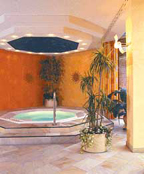
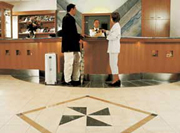
Pointing to the durability, maintenance and hygienic benefits of ceramic tile in addition to aesthetics, the owners at Hotel Vierjahreszeiten were persistent in their mission to use ceramic tile while sustaining a peaceful atmosphere. And in the end, tile was used throughout the building, and the only carpeted areas of the hotel include a small strip in the hallway, and a section of the conference area.
The hotel boasts 72 guestrooms, two restaurants, a bar area, a huge outdoor terrace, a convention center and a complete wellness center, including a sauna, fitness area and spa. A wide variety of colors and patterns were specified for all of the different tiled floors and walls, complemented by furnishings and other d?r to highlight their tones.
Overlooking the lake, the 3,700-square-foot terrace is covered with Korzilius' Mont Martre tile. Though used exclusively in the summer months, the generous exterior seating area is a noteworthy example of the potential for exterior tile applications, even in a northern climate.
The guest bathrooms, in which the incorporation of tile is expected, are also particularly impressive. Trim profiles were installed to protect and decorate outside corners of tiled edges. The designer specified stainless steel profiles to match the aesthetics and quality of the high-end bathroom fixtures. Where tiled surfaces meet in vertical corners and floor-to-wall connections, prefabricated expansion joints create graceful, hygienic corners, eliminating the need for caulking. Through the effective use of movement and trim profiles, the guest bathrooms -- as well as the spa, restaurants and state-of-the-art kitchen -- are maintenance-free as well as aesthetically pleasing.
One of the most unique ceramic tile applications in the hotel's design can be found in the guestrooms, which were designed with ceramic tile throughout, as opposed to typical. This achieved the upscale feel that the owners wanted for the hotel, while also reducing the workload for the cleaning staff.
The Hotel Vierjahreszeiten represents an innovative approach in every aspect of its complete renovation. In fact, through the use of two diesel generators, it creates all of its own energy, including all of the required electricity and hot water for the kitchens, bathrooms and the integrated radiant heating tubes. Consequently, the hotel is entirely self-sufficient.
Beneath the surface
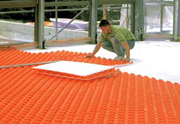
The solutions for creating a quiet, comfortable floor lie beneath the surface. The floor assembly was constructed with integrated radiant heat, along with sound and heat insulation. These features were easily incorporated using innovative installation methods.For ceramic tile flooring, radiant heat has long been touted as a highly efficient heating method. The floors of the Vierjahreszeiten were constructed using the Schluter [R]-Bekotec Modular Screed system, which was developed specifically to address the negative perceptions associated with tiled surfaces, such as cracked tile, coldness, noise, weight and construction time.
A conventional radiant heated floor assembly consists of the following three components: an insulating layer, which is placed either beneath or on top of the subfloor; heating tubes, which are installed with special fasteners; and a thermal mass comprised of approximately 2 inches of poured screed, or mortar, which is placed over the tubes. When warm water flows through the tubes, the screed mass both stores and radiates the heat. The insulation layer beneath the assembly ensures that the heat radiates up through the floor, effectively heating the living space, and preventing heat loss below the assembly.
In this conventional installation, however, stresses occur while the screed cures. The screed typically shrinks, and sometimes curls during the curing and evaporation process. In fact, a self-supporting screed can shrink up to 1/2 inch per 10 feet. These stresses in the screed manifest themselves as long, continuous cracks. These cracks will ultimately transfer to the finished tiled covering, creating permanent damage. Therefore, control joints are installed at regular intervals in the screed to control the location of these cracks.
A modular screed system, on the other hand, is comprised of lightweight studded polystyrene panels. Microfine cracks develop between the studs during the curing process, effectively dividing the screed into smaller, 4 1/2-inch modules. This confines the curing stresses to each module, eliminating the need for control joints in the screed. Therefore, freedom of design is possible in the tiled covering, as it is much easier to match surface movement joints to the pattern of the tile or stone covering, instead of matching the surface joint to the joint in the screed below.
The lightweight modular screed panels, which also serve as a thermal break, are integrated with the thermal mass (as opposed to two separate elements), and displace about half of the screed mass that is used in a conventional installation. Since the screed mass to be heated is much smaller, recovery time is much quicker than can be achieved with conventional systems, further increasing energy efficiency. Additionally, the heating tubes in this system are very close to the surface of the tiled covering, resulting in a much faster response time and precise control of the room temperature at lower water temperatures, significantly reducing energy costs. The smaller amount of screed material required, in addition to the ease of installation, also decreases installation time and the weight of the assembly.
The complete system also includes an uncoupling membrane, which is installed between the screed and the finished tiled covering. Although the modular screed panel neutralizes stresses in the screed through the formation of microfine cracks between the studs, the covering itself requires an uncoupling membrane in order to compensate for the expansion and contraction that occurs during the heating and cooling cycles. A screed that is subjected to these cycles can expand at almost twice the rate of the tiled covering. Additionally, the open rib structure of the uncoupling membrane effectively distributes the heat evenly throughout the floor covering and eliminates thermal striping, which is common in conventional radiant heated flooring assemblies.
The Vierjahreszeiten's "Wintergarten" restaurant serves as an example of the benefits of this installation system. The Wintergarten is a spacious, bright, glass structure that seats 50 people and is used as a restaurant and breakfast area. The floor construction began on a Wednesday when the Bekotec panels were placed on top of an additional insulation layer and the heating tubes were simply set into the studs of the Bekotec without fasteners. On Thursday, the screed was poured on top of the Bekotec. Friday, the uncoupling membrane was installed. Tile setting began immediately, and was completed on Saturday. With the floors completed, other contractors were then able to access that room to work on the ceiling and walls.
Largely due to the ease of the floor installation, the entire renovation of this four-star establishment was completed in only seven months. The application of a completely unique approach to this renovation resulted in this self-sufficient model of energy efficiency. With over 10 times the quantity of tiled surfaces as compared to a traditional hotel, the Vierjahreszeiten exemplifies innovation in design.
Hotel Vierjahreszeiten (Four Seasons Hotel) Iserlohn, Germany
Architect: Walter Ebeling, IserlohnInterior Designer: Dipl.-Ing. Architect Cornelia Neuser, Castrop-Rauxel
General Contractor: Schluter Tile
Tile Manufacturers:
- Villeroy & Boch "Indian Stone" 30 x 30 cm (guestrooms)
- Villeroy & Boch "Pro Architektura" 10 x 10 cm (bathroom floors)
- Villeroy & Boch "Elektra" black polished (corridor floors)
- Villeroy & Boch "Elektra" polished, other colors (corridor walls)
- Italgraniti stoneware rustic, 15 x 15, 15 x 30, 30 x 30 cm, stretcher bound with broken joints (bar)
- Villeroy & Boch "Elektra," with metal ornaments in front of the reception and other ornaments cut out of 60 x 30 cm "Elektra" tiles (entrance hall)
- Villeroy & Boch "Elektra" ("Seeblick" restaurant, stairwell, conference center "Atrium")
- Korzilius -- ("Wintergarten" Restaurant)
- Korzilius "Mont Martre" (terrace)
- Megaceram (wellness center)
Tile Installation system components:
- Schluter[R]-RONDEC trim profiles
- Schluter[R]-DILEX expansion and movement joints
- Schluter[R]-Bekotec Modular Screed[TM] System
- Schluter[R]-DITRA uncoupling membrane
- Schluter[R]-KERDI waterproofing membrane
- Schluter[R]-KERDI-DRAIN floor drain (guest bathrooms, exterior terraces, and kitchen)
- Schluter[R]-TROBA drainage membrane (exterior terraces)
Looking for a reprint of this article?
From high-res PDFs to custom plaques, order your copy today!