Installing stone in wet areas
Have you ever had someone tell you that you cannot use stone in wet areas? It simply is not suitable? It is too slippery? It may be too hard to maintain? Frankly, these are fallacies and issues that can be overcome.
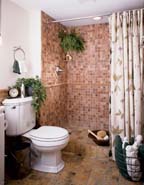
In today's construction marketplace, stone is a design material that should indeed be specified for use in wet areas. The objection that stone is not suitable for wet areas, simply does not apply. You can find stone with all types of surface treatments that make it appropriate for use in wet areas. Stone is readily available in thermal finishes (with a rough surface texture) and honed finishes (a dull surface finish that is not highly polished). These finishes are ideal for the “walking†surfaces in wet areas, as they are not slippery at all. In addition, you can still use the polished surfaces of the same material for all vertical applications, wet or dry.
Another stumbling block may be that the stone darkens when wet, and one can see shadowy spots on the face of the stone. This objection is easily overcome by following good installation practices. If the stone is fully bedded in accordance with industry standards such as ANSI and NATC requirements, the dark spots should not be an issue.
What are the challenges of installing stone in wet areas?
The stone being used for any application should be carefully chosen. Some types of stone may not be suitable for exterior vertical applications or exposed to moisture. Also, some of the backings that are showing up on some stones may have limitations that restrict their use in some applications. Make sure that the stone manufacturer or supplier of the stone recommends the material you desire for your specific application. There are also some installation considerations that can make stone applications in wet areas successful.Are there specific waterproofing and surface requirements?
Wet areas and most, if not all, exterior applications will require a waterproofing membrane. This will protect the substrate cavity and spaces that are below or adjacent to the application. There are many membranes which are thin and load bearing that will not add any appreciable thickness to the installation. In order to apply the waterproofing membrane, the substrates should be properly prepared. They should be free of any bond-breaking or bond-inhibiting materials. These bond-inhibiting materials can include sealers, waxes, curing compounds, form release agents, paint, dirt, grease, oils, laitance from overtroweling, etc. If these materials are present on the substrates, they must be completely removed prior to the commencement of the installation. Mechanical abrasion is the best way to remove these contaminants. Avoid using chemicals or acids to remove contaminants. These chemicals or acids can get into the substrate, and will be virtually impossible to thoroughly remove. The local building code can also be consulted for information on size, height and weight limitations for exterior direct-adhered applications.What are the adhesive mortar requirements?
After the waterproofing membrane is applied and has cured, use an appropriate thin-set mortar for the substrate that will receive the stone to ensure a proper bond. Exterior applications should only be installed over concrete or masonry type surfaces. The substrates should be rigid and structurally stable -- and they should not experience excessive deflection. Exterior applications will be more demanding due to weather conditions, freeze/thaw cycles, wind load and thermal expansion -- just to name a few factors. The project engineer should carefully detail the installation system to ensure that all of these factors are considered prior to the installation of the stone. Industry standards require that installations of stone and tile in wet or exterior areas have a minimum of 95% thin-set mortar coverage. Back-troweling the stones and periodically checking the bond and coverage will provide a good gauge to determine if the coverage is appropriate. The less voids an installation has, the better the application will be, and this will eliminate those problematic water spots on the stones.What are the expansion joint requirements?
Expansion allowance should always be included in any stone installation. Exterior installations will require more frequent and wider expansion joint placement. The project architect or engineer should provide direction on the design, placement and construct of all expansion joints. The sealant chosen for these joints should also be durable, weather resistant and be able to handle the movement that it may be subjected to. Typically, silicones and urethane sealants are best for these applications. Latex or acrylic caulks are only suitable for interior non-wet areas. Most of the sealants produced match the grout or stone colors to blend in with the entire color scheme of the installation.Are there grouting requirements?
Generally, latex-fortified, Portland cement-based grouts are used for exterior veneers. Consult with the grout manufacturer on limitations for exterior applications. For better performance, interior applications or all submerged applications (interior and exterior), an epoxy-based or new generation cross-linking grout can be used. The epoxy and cross-linking technology grouts provide superb performance and color fastness. They are also stain resistant and are easier to maintain, as they never need sealing.Summary
In conclusion, stone can be successfully installed in wet area applications both for interior and demanding exterior applications. In order to continue the great increase in stone consumption, we need to continue to provide high-strength, quality installation materials and to back these products up with good sound and accurate installation information.Looking for a reprint of this article?
From high-res PDFs to custom plaques, order your copy today!