Enhancing Sustainable Architecture with Stone

From its inception in 2005, the Visionaire - a
luxury residential high-rise in Manhattan
featuring an extensive use of stone - was targeted for LEED Platinum
Certification from the Green Building Council. The building represents the
third green residential project designed under the collaborative leadership of
Albanese Development Corp. and Pelli Clarke Pelli Architects. Photo by Heidi
Kippenhan/Courtesy of Pelli Clarke Pelli Architects
The sleek design of the Visionaire - a luxury residential high-rise in Battery Park, New York City - is not only a testament to the aesthetically pleasing results of the use of stone in architecture, but it is also an example of environmentally friendly building. The design was conceived in 2005, and from the beginning, the Visionaire was targeted for LEED Platinum Certification from the Green Building Council. The building represents the third green residential project designed under the collaborative leadership of Albanese Development Corp. and Pelli Clarke Pelli Architects.
When choosing stone for the building’s exterior, the architects looked beyond the Green Building Council standards. “We chose stone for prominent and public areas, like the building base, capitalizing on important and intrinsic sustainable qualities of enduring natural beauty and strength,” said Craig Copeland, Senior Associate at Pelli Clarke Pelli Architects and the project’s design team leader. “These qualities transcended the quantitative measures of LEED.”

Jet Mist granite, which was quarried in Rapidan, VA,
by Granites of America, was utilized for the exterior base of the building -
complementing the glass and terra-cotta facade. Photo by Jennifer Adams
“As we developed the curtainwall design, we shaped the terra-cotta panels into expressive horizontal bands that would play off of the building’s curving form,” said the architect. “For similar reasons, we continued architectural banding at the base, but in stronger and larger panels of granite.

The granite was given a waterjet/flamed finish,
which makes the stone resilient to oils and staining in general. Photos by
Jennifer Adams
According the architect, the 1 5/8-inch-thick granite pieces are of varying sizes with the average measuring 3 feet, 8 inches tall x 6 feet long. They were all given a waterjet/flamed finish. “It gives the surface a softer and warmer tone and also makes the stone resilient to oils and staining in general,” he said.

The 1 5/8-inch-thick granite pieces are of
varying sizes with the average measuring 3 feet, 8 inches tall x 6 feet long.
Photos by Jennifer Adams
The fact that the quarry is within 500 miles of the project site qualified the granite as a green building material. And Copeland believes that the material’s intrinsic sustainable qualities of strength and “timeless grandeur” made it a logical choice for the project. “Stone is the only natural material that I know of that can welcome and sustain such important physical contacts between a city and a building, a building and its people,” he said.
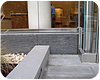
“We wanted the same base stone to have a variety
of readings,” said Craig Copeland, AIA, Senior Associate with Pelli Clarke
Pelli Architects. Photos by Jennifer Adams
A Stone Interior
Inside the Visionaire, an extensive use of Italian travertine - supplied by Henraux S.p.A. of Querceta, Italy - is featured in the lobby. “We wanted the walls to have grand material substance,” said Copeland. “We chose travertine, with its expressive striations that really give one a sense of the earth.”The architect explained that Classico travertine was used in tandem with Noce travertine to create a warm modern feel in the space. “We wanted to create an interesting composition of stone walls,” he said. “Because there were so many geometries culminating in the lobby, we organized the stone walls into floating planes that defined a clear but open orthogonal backdrop. The rustic surface of the travertine helped offset the massive forms.”

A total of 10,000 square feet of Jet Mist
granite was utilized for the exterior base of the Visionaire. The stone pieces
were fabricated by Lacroix et Fils Granit Ltée of Saint-Sébastian, Quebec,
Canada. Photo
by Jennifer Adams
“We chose not to use grout because we wanted a clean look, and we wanted the stone to seem like it is floating,” explained Copeland, adding that all of the corners were shop fabricated. “We wanted the grout to be shallow, only as deep as needed to support the stone above it. What emerged was an efficient, contemporary way to use stone.”

Inside the Visionaire, an extensive use of
Italian travertine - supplied by Henraux S.p.A. of Querceta, Italy
- is featured in the lobby. Photo by Craig Copeland/Courtesy of Pelli Clarke
Pelli Architects
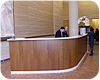
The lobby walls are formed by 1- x 4-foot panels
of Classico travertine, which were dry set.
Photos by Jennifer Adams

Further contributing to the overall contemporary
look of the lobby is a feature wall behind the concierge desk where a sculpture
entitled “La Sirena,” which means mermaid, is chiseled in stone. Photos by
Jennifer Adams
Complementing the travertine wall panels, the top of the concierge desk is fabricated from Crema Marfil marble with a polished finish. Noce travertine was used for the recesses of the feature walls, including the base trim. “We used the material in these areas to enhance the depth of the walls’ relief,” said the architect.
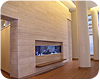
Two feature walls were developed in the lobby -
one behind the concierge desk and another that displays a 12-foot-long
saltwater and living coral aquarium, separating the main lobby from the
children’s play area. Photos by Jennifer Adams
“It is very important to pace yourself [with a building of this size],” said the architect. “You can’t just focus on the big things. You need to remember the small things too. You also need to be sensitive to the larger, emerging opportunities. In the lobby, because we have so much glass, the stone comes out to the street. It glows and really allows us to convey the beauty of the material, and the sustaining beauty of nature itself.”
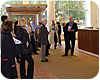
Architect Craig Copeland, AIA, Senior Associate
of Pelli Clarke Pelli Architects in New York, NY, led American Institute of
Architects (AIA) members who were earning LU credits toward their accreditation
on a guided tour of the new Visionaire residential high-rise in Battery Park,
New York City.
Sidebar: Visionaire
Battery Park CityNew York, NY
Developer: Albanese Development Corp., New York, NY
Architect of Record: SLCE Architects, New York, NY
Design Architect: Pelli Clarke Pelli Architects, New York, NY
Environmental Design Firm: Atelier Ten, New York, NY
General Contractor: Turner Construction, New York, NY
Stone Quarriers: Granites of America-Rapidan, VA, quarry location (Jet Mist granite); Henraux S.p.A., Querceta, Italy (travertine)
Stone Fabricator: Lacroix et Fils Granit Ltée, Saint-Sébastian, Quebec, Canada (Jet Mist granite); Henraux S.p.A., Querceta, Italy (travertine)
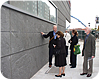
Speaking on the specific stones used, the
architect explained that Jet Mist granite, which was used for the exterior
base, is considered green because it is a natural material that was quarried
within 500 miles of the project site.
AIA Architects Receive Guided Tour of the Visionaire
Veronafiere - the trade fair company that owns and manages Marmomacc, a leading international stone exhibition that is held annually in Verona, Italy - collaborated with MAPEI, a leading manufacturer of maintenance and installation products, to host a two-day seminar program that allowed architects to earn LU credits towards their accreditation for the American Institute of Architects (AIA). The event was held on November 6 and 7, 2008 in Manhattan. The architects participating in the program were alumni of previous educational trips, which are sponsored annually by Veronafiere and coincide with Marmomacc each year.Among the presentations during the two-day event was one entitled “Enriching Sustainable Architecture with Stone - A Recent Case Study: The Visionaire, New York City,” which was led by Craig Copeland, AIA, Senior Associate of Pelli Clarke Pelli Architects in New York, NY. This session consisted of an on-site visit to the Visionaire, a luxury residential high-rise in Manhattan that was designed by Pelli Clarke Pelli Architects in collaboration with Albanese Development Corp. The building is targeted for LEED-Platinum certification from the U.S. Green Building Council, and it was also the recent recipient of the 2008 EPA New York City Green Building Competition Grand Prize.
During the guided tour, Copeland explained that the building’s exterior stone base and interior stone lobby are considered to be environmental friendly and contributed to the overall green design of the building.
“From the beginning, we talked about enhancing a sustainable project with stone,” said Copeland. “The two fundamental reasons why we chose stone were because it has been around a long time and for its beauty.”
Speaking on the specific stones used, the architect explained that Jet Mist granite, which was used for the exterior base, is considered green because it is a natural material that was quarried within 500 miles of the project site.
The tour presented architects with the opportunity to gain insight into the steps taken during the design process to produce a LEED-certified building as well as observing the final result.
Looking for a reprint of this article?
From high-res PDFs to custom plaques, order your copy today!