A vision for marble is made sacred
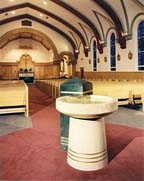

“Our goal, as is the goal of many churches today, was to update the church to the 'Modern Liturgical Standards,' and to bring back the architectural character; the best features,†said Architect Paul Bormann of Bormann Eitemiller Architects. Before the renovation, the whole church had been painted over white, and the only distinct characteristic was the terrazzo floor. The addition of three marble pieces, the ambo (podium), the altar and the baptismal font, which were all fabricated from green Verdi Alpi and warm beige Perlato Svevo Italian marble, blended seamlessly with the terrazzo tiles.
“These marble pieces are one step above the marble floor; they hone in the authenticity,†said Bormann. “The Sacraments, the most sacred events of the Catholic Church, are preformed in and on these stone pieces. There is no other material that portrays the authenticity or permanence that is prevalent in the Catholic Religion than marble.†The project began under Pastor Marcian O'Meara in 1998 and was completed in 2004 by Pastor Neil Pfister. “Shortly after the unfortunate death of Pastor O'Meara, many initial aspects of the renovation were already finished,†said the architect. “When Pastor Pfister took over, he increased the project. He continued renovations with the ambo and altar in the same vein, yet reflected some of his own character.â€
One particular difficulty arose during the second addition of the ambo and altar. The Denver Marble Co. was hired to do the installation of both pieces, which took about half a day. “It was especially challenging to find a matching block, since there was five years in between the fabrication of the font and the ambo and altar,†said Scott Polack of The Denver Marble Co. “We had to send many samples back and forth from Italy until we found that perfect block.†Additionally, Denver Marble made a full-size mock-up of the first ambo design out of cardboard, and placed it in the church to help both Father Pfister and Bormann visualize the size and shape. As a result of the mock-up, the final design on the ambo was modified. To shed some pounds from the heavy ambo, the inside of the middle shaft was hollowed out, which also allowed for room to hide unsightly wires and cords.
The new design of the church included painting and carpeting as well. A rust-red colored carpet was used to establish a regionalistic relationship with the state of Colorado, whose landscape is coated with the color, and a soft green paint was used on the woodwork of the frame of the ceiling to complement the green marble.
Since the 1960s, baptisms were no longer performed in baptisteries, which used to be separate from the church. Due to this fact, a larger area surrounding the baptismal font was needed, which is the main idea behind the “Modern Liturgical Standard.†“The main thrust of entire project was to update the baptismal font at the back of the church, so that extended families could participate in the sacrament of baptism,†said Bormann. By using the brightness of the red carpet, a large circular area was inlayed down the main aisle and then around the marble font to extend it so large gatherings could comfortably participate in the sacrament.â€
Gold bands, cast by Denver Marble, were also used to accent the marble. “The banding, or reveals, helps to modulate the base of each object,†said the architect. “It feels like they are sitting in the ground. The gold also relates to some of the existing gold fixtures, like candles, lamps and the tabernacle, tying it all in.â€
Architecture has always been the foundation of churches, especially in the Catholic Religion. Old World churches manifest this with massive stone facades, elaborate mosaics and monumental furniture such as alters, fonts and podiums. “The Catholic Church, architecture and stone have had a long collaborative relationship, and in this project, we wanted to blend the three worlds together,†said Bormann.
Despite valiant efforts, there were a series of small challenges throughout the project. However, getting each 2,000-pound marble hunk into the church was not one of them. “The renovation was embraced by everyone who was in a decision-making position -- from the financial end to the church committee; the designers to the contractors,†said the architect. “Getting everyone to agree, because multiple parties were envisioning the final design, was really difficult especially since the product was being produced in Italy.†To solve the problem of being limited by only an abstract vision, Bormann -- along with designers -- forged a series of models, which were “very instrumental in determining the final design,†said the architect.
One parishioner commented to Bormann that the marble pieces must have cost a lot of money. “The marble pieces cost as much as the painting and carpeting,†he replied. “However, the marble will last 10 lifetimes, whereas the paint and carpet will always need replacing eventually.†According to Bormann, the general consensus has been extremely positive. “Many parishioners were stunned by the material,†he said. “People underestimate marble's beauty. This renovation really exhibits marble at its best.â€
End box:
The Church of the Good Shepherd, Denver, CO
Restoration Architect: Bormann Eitemiller Architects, Denver, COStone Installer/Fabricator: The Denver Marble Co., Englewood, CO (altar and ambo)
Stone Supplier: Metro Marmi E Graniti S.R.L., Avenza, Italy (altar, ambo and font)
Stone Fabricator: Antonio Selva-Brick, Toronto, Canada (font)
Looking for a reprint of this article?
From high-res PDFs to custom plaques, order your copy today!