A union among German limestone producers
In the mid 1980s, several quarriers of German limestone came to the realization that they would be more profitable if they pooled their resources and worked as a team. This led to two years of negotiations to formulate a plan of operation. In 1986, the JMS Group was formed, which today includes seven companies.
"There was this big project in Saudi Arabia -- the King Fahad Medical Center -- which needed 4 million square feet of Jura stone," said Gerhard Ruf of the JMS Group. "No single Jura supplier could do it." This project was what initially sparked the idea to work together, and almost 20 years later, they are still experiencing success.
"JMS has had quite a time of history in the stone business," said Ruf. "We've had ups and downs -- different companies have come and gone -- but it's had a lot of success." He explained that through the years, some businesses in the group merged, others stepped out and one went bankrupt.
Headquartered in Eichst? -- a quaint medieval-style town that sits between Munich and N?rnberg -- the administrative office of the JMS Group is comprised of five employees, but the entire group has approximately 600 workers. It includes seven facilities for processing Jura stone and two for fabricating limestone from the Solnhofen region.
The seven companies that currently form the JMS Group all operate their own quarries and factories, and each has a specialty to separate it from the others. While some focus on producing split-faced material for cobblestone, other companies have capabilities for waterjet-cutting or wire saws for curved surfaces. There is a company that specializes in customized work and one equipped with gangsaws.
When exporting outside of Europe, the members of the JMS Group operate as one unit. "It's expensive to promote worldwide, so all the companies collaborate," said Ruf. "One couldn't do it alone." Currently, the U.S. is the primary market for JMS, and Japan is the second largest. The group has a holding company, Jurassic Stone Co., based in Manassas, VA.

The quarrying region
The majority of the Jura limestone operations are located around the banks of the Altm?hltal River, according to Ruf, who added that the enterprise has approximately 13 operating quarries. Many of the JMS Group's quarries are in the town of Titting, and several are in Pappanheim. "The Jura area is quite big," said Ruf, explaining that the region spans about 50 x 15 miles (750 square miles). "It's a large area where you have everything."The land surrounding the quarrying sites is lush green countryside. The scenic ride along the roads leading to the sites differs drastically from the steep, narrow, winding paths, which are quite common in other stoneworking areas such as Italy. Great measures are taken to preserve these grassy surroundings. "We have to show a plan to the local government of how we will re-cultivate in order to get the license to quarry," said Ruf. "As we go forward [in the quarry], we refill the land."
In each quarry, the stone is extracted in as much as 25 layers, providing a diverse range of color and texture. Among the stone types offered by JMS are Jura Grey and a number of beige varieties -- ranging from a light cream color to brown. The geology of the stone dates back to the Jurassic Period, which is approximately 140 million years ago. The material contains fossil evidence of prehistoric flora and fauna, contributing to the rich characteristics of this type of limestone, according to JMS.
As a group, JMS produces an annual block capacity of approximately 50,000 cubic meters, according Ruf. Being that JMS does not quarry during the winter months, its operating season runs from March through November.
At the time of Stone World's visit to one of JMS's quarries in Titting, five workers were at the site. "It's flexible depending on what the demand is for," said Ruf. "At the moment, all the beige colors are a favorite."
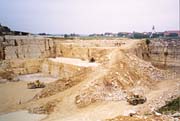
This quarry was equipped with a Tamrock driller, hydraulic splitter, two Caterpillars, a Komatsu hammer and front-end loaders. The site was about 100 feet deep. "We don't go further down than that," said Ruf. "We go out."
When looking to the future, the JMS Group plans to continue working hard to achieve success, according to Ruf. "We think we're on the right track," he said. "We want to strengthen our position."
Side Bar
The history of Jura Stone in Munich
When touring the streets of Munich, Germany, it's difficult to imagine that this bustling city once laid in a heap of rubble -- caused by the destructive forces of World War II. But although the city, which was founded by Duke Henry the Lion in 1158, experienced a tremendous amount of devastation, a rebuilding plan implemented after the war has re-established Munich as a rich resource for art and culture, and a popular tourist destination.The city sits to the north of the Bavarian Alps, on the Isar River, in the southern region of Germany. Con-tributing to the charm of Munich is its architecture, which was rebuilt throughout the years following the war, and also includes new construction that is still going on today. One common trait among Munich's architecture is the building material. Realizing that the surrounding region is plentiful in Jura limestone, architects -- both in the past and present -- take advantage of the city's location and utilize this resource in their designs.
"The buildings in Munich are different ages -- 15, 20, 30-plus years old, but all are built with Jura Stone," said Gerhard Ruf of the JMS Group, a collective producer of German limestone. Ruf explained that he often gives architectural tours in Munich, pointing out the different uses of the material throughout the decades. Most recently, he had been host to two separate groups of architects -- one from the U.S. and one from Japan.
Years ago, the areas surrounding Munich were all gravel, explained Ruf. "Stone had to brought in from some distance," he said. "Because of the glaciers, the land in the Munich area is flat, which made it easier to bring the stone in." And it is for this reason, that Jura Stone remains such a predominant building material in the city. "After the 1800s, the 'Stone Age' started in Munich," said Ruf.
When studying the various buildings in Munich, the differences become obvious. Those built in the 1950s have more simple designs than those constructed more recently. Some older buildings have been cleaned, while others have not. In one example, the Jura Stone on the bottom portion of a retail building appears darker because an anti-graffiti product was used when the structure was cleaned, Ruf explained.
The JMS Group is actively involved in new construction taking place in Munich. The Max Planck Institution, which was built five years ago, is an example of a more modern approach to architectural design. The building's exterior is comprised of Jura Stone pieces -- approximately 35 x 35 inches -- that are not grouted. "The joints are left open so water can get in and out," explained Ruf. A glass facade was also placed around the stonework. According to Ruf, this acts as a heating/cooling system, which cuts back on air-conditioning and heating expenses. The interior flooring in the office building also features Jura Stone.
Currently, JMS is involved in the construction of another commercial building within the city. The exterior design incorporates honed Jura Stone pieces with smaller rough-cut ones. Ruf explained that the pieces with the rougher texture were taken from the top layer or crust of the quarry.
Looking for a reprint of this article?
From high-res PDFs to custom plaques, order your copy today!