A Solemn Display of Remembrance
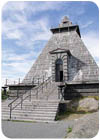
The architecture of “Minnehallen†(Remembrance Hall), Norway's monument to fallen sailors, is defined through the use of Larvikite, a granite quarried in the nearby Larvik region. Built in 1926, the structure features a unique, pyramid-shaped construction.
Text and photos by Michael Reis
Hiking along the massive stone formations of the Coastal Trail in Stavern, Norway, one is afforded sweeping views of the North Sea and beyond. But in addition to the trail's natural beauty, walkers are also struck by the simple, dignified elegance of the “Minnehallen†(Remembrance Hall), Norway's monument to fallen sailors. The building, which stands as a beacon of strength and permanence atop a large stone formation, was constructed using Larvikite, a form of granite quarried in the nearby Larvik region.
The monument was constructed in 1926 by builders from Bahuslen, under the direction of King Haakon. As the building was being constructed, every stone was taken out of the quarries by hand and carried to the area by horse and wagon. The structure features a unique, pyramid-shaped construction that adds to the monument's status as a landmark welcoming all sailors to Stavern.
Although the architecture of Minnehallen is relatively straightforward, it projects a strong presence through simple geometric forms and details. The granite used for much of the exterior features a rough, textured surface with wide joints adding to the overall look. After climbing an impressive, arched stairway to reach the monument's entrance, visitors can explore a terraced walkway that allows for 360-degree views of the North Sea and the village of Stavern as well the countless inlets that define Norway's coastline. A second, smaller walkway sits just below the peak of the building, although this is only accessible to the monument's caretakers.
At the base of the monument, below the walkway, the blocks are larger and rougher, with deeper and wider joints. This serves to anchor the building to the landscape, and makes it appear to be “sharing†the hilltop with the surrounding outcroppings, rather than having been built on top of them.
Some of the most impressive stonework can be found at the entrance, where the material is more detailed, with hand-chiseled blocks surrounding the main doorway, separated by smaller, rough-faced pieces. A chiseled keystone rests just above the doorway, and the entire entryway is capped by a basic, yet substantial cornice. All of these elements lend an air of importance and formality to the entrance, subtly reminding visitors that - even while the structure sits within an idyllic setting for tourists - it is also a monument for those who lost their lives in battle. Inside the monument, the names of all 7,562 fallen members of the Norwegian Merchant Fleet are outlined on 28 copper plates and inscribed in four memorial books, thus assuring that Minnehallen's original function as a memorial will not be forgotten.
A Tradition of Larvikite
While Minnehallen dates back nearly 80 years, Larvikite's history as a building material in the region dates back much further. According to Lundhs Labrador, AS, a major quarrier of virtually all the Larvikite granite varieties in the region, the material has been used in monuments, cliff drawings and for daily purposes in Larvik since prehistoric time. The oldest sculptural art is found in medieval churches from around the year 1000, and the stone was used in symbols and relics from the earliest days of the christening of Norway.Lundhs reports that Larvikite was first studied as a geological phenomenon in 1794, when a Danish scientist discovered the stone's unique color and tried to find a scientific explanation of its beauty. It was discovered that the granite of the Larvik area originated during an intense magmatic period in the Oslo region about 270 million years ago. After years of erosion, the stone became accessible to large-scale quarrying operations, and the material is now sold around the world under well-known names such as Blue Pearl, Emerald Pearl, Pearl Grey and Marina Pearl, among others.
Although the stone most commonly extracted as gray, gray-blue or blue material, greenish and reddish varieties have also been found. The different colors reflect the chemical composition and amount of feldspar present in the rock. Polishing the material brings out a vibrant, mother-of-pearl luster, and as a result, it is most commonly found with a highly polished finish. The stone has been specified around the world for applications such as residential countertops (one of its most common uses), high-end boutiques and even large-scale commercial projects such as One Liberty Place in Philadelphia, PA.
At Minnehallen, however, the design scheme was chosen to keep the granite's lustrous qualities silent - a fitting show of respect and reverence for the fallen sailors of Norway.
Looking for a reprint of this article?
From high-res PDFs to custom plaques, order your copy today!