Historic 19th Century quarry reopens
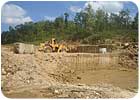
Dunnville Cutstone Co.'s quarry, which dates back to the late 1800s, reopened in 2005 and currently operates on 107 acres of land just 10 miles north of Menomonie, WI.
Dating back to the late 1800s Dunnville Cutstone Co.'s historic quarry - located on 107 acres of land just 10 miles south of Menomonie, WI - reopened in 2005. The site yields Dunnville sandstone, which is reported to be one of the oldest quarried dimensional stones in Wisconsin, if not the Midwest, according to Aaron Keopple, the company's president.
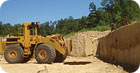
The quarry is equipped with a CAT 980C front-end loader.
The quarry is equipped with a CAT 980C front-end loader.
Historic quarry
Like many of the older quarries in the U.S., the Dunnville sandstone site has a storied history. In the 1880s, a branch of the Milwaukee Railroad built a track running through the Red Cedar River Valley in Dunnville, WI, and it was during these efforts that high-quality sandstone was discovered and later named Dunnville sandstone. From there, four quarries began to extract large amounts of sandstone for local foundations, barns and buildings. In addition to the local market, large amounts of Dunnville sandstone were shipped to the Eastern U.S. for use in projects such as rowhouses commonly known as “Brownstones.â€In one of the first major commercial projects using the material, the Mabel Tainter Theater in Menomonie was constructed exclusively of Dunnville sandstone in 1889. Scottish stone carvers completed the extensive carving on the entrance, and after over a century of weathering, the detail is still breathtaking, according to Keopple. The company is currently in the works to supply additional sandstone for an expansion to the theater. “I have been in discussions with Miller Dunwiddie Associates, Inc., who is the architectural firm working with the project,†said Keopple, adding that the addition will address handicap accessibility issues, along with repair and restoration of internal infrastructure (plumbing, electrical, etc.). “The front arched entryway will remain intact, and the addition will take place on the rear elevation,†he said. “John Stark, an architect with Miller Dunwiddie Associates, said to me, 'It's not often a quarry is still open that can replicate the stone from 117 years ago.' “

The current quarrying process involves drilling 1 ½-inch holes, spaced 10 inches on center. The company then blasts with low grain detonation cord and B-Gel as its stemming, which has proven to be the lowest cost and highest yielding method, according to Keopple.
Outside of the Midwest, Dunnville sandstone was used for the high altar of the Saint Thomas Church at Fifth Avenue in New York in 1910. Keopple said that Dunnville stone was selected for the project because the specified stone from Cannes, France, was inaccessible during the First World War due to the shipping embargo. “At that point, the architects and sculptors decided on a type of stone which could only be found in the Dunnville quarry,†he said. “Huge slabs were shipped to New York and set in place on the altar, and French stone carvers worked for three years carving the life-sized figures and lattice. They used it to form 60 life-sized figures in the altar under the direction of Lee Lawrie. The Saint Thomas Church was built for John D. Rockefeller, completely of stone, to show him something in the world besides gasoline. The finished cost of the altar was $350,000.â€
In 1999, the property that lies between two of the four historic quarries was purchased, and six months later, the land to the south was purchased. This land contained Ulmer's quarry, which was the second to last to shut down. “It shut down as a dimensional stone quarry due to fire and began operation as a rip rap quarry,†said Keopple. “The stoneworkers then moved to the last operating dimensional quarry, which was operating ¼ mile to the north.â€

In the 1880s, a branch of the Milwaukee Railroad built a track running through the Red Cedar River Valley in Dunnville, WI, and it was during these efforts that high-quality sandstone was discovered.
Reopening the site
The inspiration to reopen the site came from a nearby renovation project. “In 2003, a local church, originally constructed of Dunnville sandstone, decided to add on,†explained Keopple. “They wanted a piece of stone from the old quarry, so they could find a good match in the current stone market. We told them to stop looking and just use some of the leftover blocks in the quarry. That is when the light came on. We felt it was a shame that existing buildings constructed of this historic stone had to be restored or added on to with a look-alike stone. At that point in time, the business started to develop with a huge learning curve.â€
After the initial discovery of the material, four quarries developed producing large amounts of sandstone for local foundations, barns and buildings.
In 2005, Dunnville Cutstone Co. incorporated and finally began quarrying Dunnville sandstone. According to Keopple, over the last year and a half, approximately 1,000 tons of dimensional stone have been quarried. “Getting beyond the dynamite fractures from the rip rap days and getting the right bit and air pressure combination were the biggest challenges in acquiring dimensional block from the quarry,†he explained.

Dunnville sandstone was utilized for the exterior facade of the Louis Smith Tainter House in Menomonie, WI, in 1890.
Current production
The quarry is now equipped with a Caterpillar 980 front-end loader, a Caterpillar 252 Skidsteer, a Tamrock Commando 100 rock drill and an Ingersoll-Rand compressor, as well as a B-Gel pumping system, which was constructed internally. In addition to Keopple, employees include a licensed blaster, driller, two salespeople and an administrative assistant.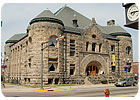
In 1889, the Mabel Tainter Theater was constructed exclusively of Dunnville sandstone, and the company is currently in the works to supply additional sandstone for an expansion to the theater.
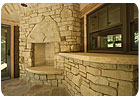
Dunnville Cutstone Co. is currently supplying material for a residential project in Grand Rapids, MN, which includes a 10-foot-long fireplace hearth.
All of the company's fabrication is outsourced to Rivard Stone in Houlton, WI, which is located about 70 miles from the quarry. Dunnville Cutstone Co.'s primary target market is the masonry sector. “Within that market, we target architectural and residential projects,†said Keopple. “Currently, we have distributors in targeted regions. Our secondary market is landscape. We have a beautiful sawn wall stone product and outcroppings.†Additional products include thin and full-bed depth veneers, sills, caps, hearths, mantles, coping and other custom cut stone products.

The exterior veneer of the residence features Dunnville sandstone in what is known as the Great Lakes Stone pattern.
Outside of various large-scale projects, the company is busy supplying to its distributors, which includes such companies as Great Lakes Stone Supply, Rivard Stone Inc., Hedberg Aggregates, Ochs Brick & Stone Co., Northland Brick & Fireplace Supply and Red Flint Sand and Gravel. “Our philosophy around distributors is to have a few good companies representing and retelling the story in every regional area,†said Keopple. “Along with the beauty of our stone, the history will always be an extremely important piece. People always ask, 'Will it last?' Well, the proof is in the history, and it is critical that the person selling the stone understands and can clearly explain the history of the stone.
“We are in the process of looking for distributors in Illinois, North Dakota, South Dakota, Iowa and other states outside of our immediate area,†he continued. “Currently, we have, or are in negotiations with distributors in Minnesota and Wisconsin.â€
The company also does contract quarrying under the name Dunnville Drilling, where they help open up dimensional stone quarries and distribute B-Gel.
Looking for a reprint of this article?
From high-res PDFs to custom plaques, order your copy today!