Collaborative effort leads to stone temple's success
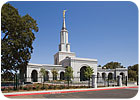
The careful planning and collaboration that went into the design and building of the Latter-Day Saints (LDS) Temple located in the Sacramento region of California helped ensure smooth construction of an inspiring religious landmark, according to Principal-in-Charge Brian Everett of Nichols, Melburg & Rossetto’s Sacramento office, which served as the architect for this project.
The careful planning and team collaboration that went into the design and building of the Latter-Day Saints (LDS) Temple - located in the Sacramento region of California - established a smooth construction process for an inspiring religious landmark, according to Principal-in-Charge Brian Everett of Nichols, Melburg & Rossetto’s Sacramento office, which served as the architect for this project.
“We approached the design from the standpoint that the building needed to be monumental, inspirational and simply elegant,” said Everett. “It needs to reflect reverence for deity because it’s a religious structure.” To achieve these goals, Temple White granite, supplied and fabricated by Bestview International Co. of Wood Dale, IL, is utilized throughout the exterior, comprising landscaping elements, stairs, columns, a water feature and the building cladding. “The stone was selected for its color and consistency,” said the architect. “The pattern in the stone was nondirectional with a very uniformed grain and very few defects.”
According to the architect, 3- x 4 ½-foot panels with a thickness of 3 cm were predominately used for the exterior facade, while areas including cornices, arches and window surrounds required more massive granite pieces. In total, the project entailed 40,645 square feet of exterior cladding and 12,135 square feet of paving and other stone products on site.
Everett explained that other colors of granite, some whiter or grayer, had been considered, with cost playing a role in the final decision. “This proved to be the best stone for the best price,” he said. “The client was very concerned with the color, look and cost. They were involved in every decision relative to stone.”
Additionally, Crema Marfil marble was selected for the floor, base material, window stools and countertops throughout the interior. “This stone had a nice neutral, warm color to it,” said Everett. “It also had an elegant grain pattern that wasn’t too overpowering.”

Temple White granite, supplied and fabricated by Bestview International Co. of Wood Dale, IL, was utilized for landscaping elements, exterior stairs, columns and the entire exterior of the building.
Preparing for installation
After careful consideration was given to material selection and design, plans for fabricating the stone pieces followed that same outline. Bestview International, with the assistance of KEPCO+ of Salt Lake City, UT, which served as the stone installer for this project, and The Facade Group, LLC, which provided detailed fabrication drawings, carefully coordinated the stone fabrication, scheduling, shipping, mockups and final installation. This ultimately reduced on-site installation time and enhanced the overall aesthetics of the temple.“Through the implementation of strict quality-control measures when selecting the granite blocks, we were able to maintain a stability and color consistency throughout the project - one of the factors contributing to its success,” said Perry Liu of Bestview International. “Another factor that led to the success of the project was the construction of a mock-up that included many of the major stone details found on the building. The mock-up was built so that the design and construction team could view a section of the building large enough to get a feel for what the completed project would look like.”
According to Liu, the mock-up was viewed by the team on their initial visit to Bestview’s facility in China, and it helped to recognize and overcome obstacles and challenges that otherwise might not have been realized until the actual fabrication of the project. The mock-up also allowed the team to confirm and finalize the quality standards for the stone.
“Many challenges were encountered and overcome during the course of this project,” said Liu. “Some of the major challenges included the fabrication of complicated details such as the radial walls, two-axis curved arches, trellis columns, arches with patterns changing at a spring-line block, etc.”
“For curved wall sections, rather than using a straight stone, we designed the stone to be fabricated with a radius in it,” Everett explained. “Detailing and then dimensioning those pieces to be erected without any modification was a challenge.”
When it came to overcoming these obstacles for the actual construction, Everett credited the expertise of KEPCO+ in allowing for a proficient installation. “We were on site two to three days a week,” he said. “KEPCO+ has very skilled workers. They knew what they were doing, which made our job of overseeing the work much easier.”

Additionally, Temple White granite was used for a water feature in the front of the structure.
Installing the stone
The duration of the installation, including the building and the site work, lasted around 10 1/2 to 11 months, according to Project Manager Mark Knaphus of KEPCO+, who assisted the owner and general contractor in stone selection during the preconstruction phase. “The client wanted to use a quality stone,” said Knaphus. “When Temple White granite from China was decided on, we gave them a larger cubic stone [in several key areas] in lieu of the veneer, which made the project more successful in achieving the classic design they sought.”The building structure was steel-framed with steel studs and structural steel along with Densglass exterior sheathing. “The client then hired someone to put a waterproof membrane over the entire building to prepare for the stone attachment,” Knaphus said. “Our attachment system used a 14-gauge track/channel that was screwed to every horizontal fashion and joint. That gave us an attachment for our stainless steel clips. Any attachment to the stone itself was done with a stainless steel attachment clip to preserve the stone’s light color.”
The stainless steel clips, which were manufactured by Metfab Metals, LLC of Orange, NJ, were custom made for this project. “We engineered and designed the attachment system, working very closely with the Facade Group,” said Knaphus. “We had all the stainless steel clips manufactured specifically for this project.”
The stone installation crew included about 28 workers, according to the Project Manager. “There was a combination of foremen, stone setters and laborers,” he said. “We didn’t really have any surprises because the project was thought out well in advance for all of that work.”
In addition, Project Architect Maury Maher, also of Nichols, Melburg & Rossetto, acknowledged that the design and planning prior to the construction were factors in ensuring a smooth construction. “There were almost no changes involved during the installation,” he said. “They didn’t have to refabricate a lot of pieces because of the design and planning that went into it. Careful detailing by the Facade Group helped eliminate the vast majority of potential conflicts in this complex assembly. Shop drawings detailed every stone, resulting in a successful combination of accurate fabrication and precise installation.”
The Sacramento Temple, which broke ground in August 2004, was dedicated in September 2006. “The overall response during the public open house was extremely positive,” said Everett. “The building is being used to its capacity by the Church members in this region.”
Furthermore, the temple was recently honored as an “Award of Merit” in the Marble Institute of America’s Pinnacle Awards.
Looking for a reprint of this article?
From high-res PDFs to custom plaques, order your copy today!