The new headquarters of Cold Spring Granite Co. in Cold Spring, MN,
was awarded LEED Gold certification from the U.S. Green Building Council
(USGBC) in December 2008. One component to the building’s LEED certification is
the use of 70% local stone from Cold Spring Granite’s own quarries within 250
miles of the project site. Further contributing to the green design, the canopy
at the outside entrance is formed by a crane that was once used at the previous
downtown industrial site.
For more than a century, Cold Spring Granite Co. has operated as a leading stone producer in the U.S. The company employs close to 1,000 people in five manufacturing locations and 30 quarries located throughout North America. As it evolved through the years, Cold Spring Granite has maintained a practice of preservation with respect to the environment. Recently, it further committed to being green by building a new 22,500-square-foot headquarters in Cold Spring, MN, which received LEED Gold certification from the U.S. Green Building Council (USGBC) in December 2008. Additionally, Cold Spring Granite continues to strive to reduce energy, waste and cost in its quarrying and fabrication processes - overall making for a more efficient operation.
“This is not a culture change for us,” said Ray Jaeger, Engineering Manager at Cold Spring Granite. “I have been with the company for over 30 years, and we are always looking for ways to reduce energy, water use, waste and ultimately cost.”

The new headquarters features a “white” roof, which
was part of the LEED certification. A total of 77% of the roof is comprised of
a white aggregate ballast material and white skylight having a Solar
Reflectance Index of 105 SRI value (low slope) and 100 SRI value
(steep-sloped). A patio area has also been set up, which allows employees to
get some fresh air on nice days.
Construction of the new headquarters was part of the final phase of Cold Spring Granite’s consolidation plan to move from its downtown location to the “West Campus” in Cold Spring. The company’s intention in doing this is to increase productivity and create a more efficient and integrated operation. Prior to constructing the new headquarters, divisions were located in separate buildings.
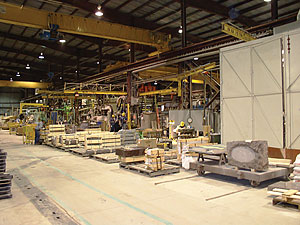
Among Cold Spring Granite Co.’s three stone-processing
facilities on site is its “Thick Stone” plant. The majority of the work done
today is thicker slabs and cut-to-size work for memorial and commercial
applications.
According to Jaeger, the company had discussed the consolidation for years, but once it made the decision to do it everything came together rather quickly.
Meeting LEED standards
The new headquarters is a 31% reduction of space from the previous facility. “That was significant to get that kind of reduction with the same amount of employees,” said Jaeger. A great deal of thought and planning went into seeking LEED Gold certification. From site planning, to minimizing water use, optimizing energy usage, indoor air quality, to material and resources for construction, all worked together to accomplish a higher-performing building. Examples include low-pressure water and low-flush toilets in the restrooms to pre-set sensor lighting and temperature control. Additionally, 90% of the space has a direct view of the outside.
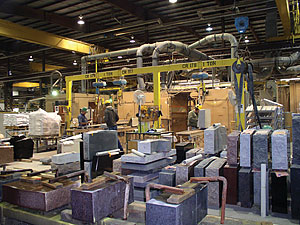
One area in the Thick Stone facility is dedicated to
the fabrication of stone monuments.
One of the components to the building’s LEED certification is the use of local materials. “We incorporated stone from Cold Spring Granite’s own quarries within 250 miles of the project site. Stone from the old office was crushed and used for base material at the construction site where needed,” said Jaeger. Additionally, CarnelianTM granite with a Diamond 100 finish was employed for the main cladding on the exterior, split-face limestone sills and medallions between the main window sections, and polished RainbowTM granite provides an accent band. Further contributing to the green design, the new building’s front entryway includes remnants of a crane that was once used at the previous downtown industrial site. Also, a large granite wall mural in the front entry was reused from the previous office.

The plant is equipped with a number of
state-of-the-art machines such as the Mill5 from Omag of Italy - a numerically
controlled stoneworking center with five axes.
The stone-processing facilities
In upgrading the facilities, the company searched for ways to save on space and produce a better workflow, which resulted in greater efficiency and less energy consumption.
Located on the same property as the new headquarters are various stone-processing facilities. Stone World recently had the opportunity to tour all three operations.
“Thick Stone” facility
Cold Spring’s facility for what they refer to as “thick stone” is more than 100,000 square feet in size. “Initially, it was all about doing monumental work,” said Jaeger. “As a result of our consolidation, we incorporated equipment from the old campus into various facilities within the new campus.”
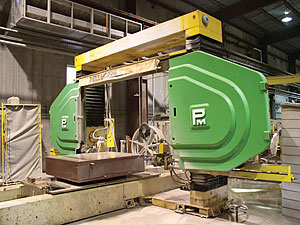
The Thick Stone facility also houses three Pellegrini
RW 2600 robotic diamond wire block cutters. These machines play a key role in
the production of cubic work.
The plant is equipped with a number of state-of-the-art machinery, including the Mill5 from Omag of Italy, a numerically controlled stoneworking center with five axes; three Pellegrini RW 2600 robotic diamond wire block cutters from Italy; and a Thibaut bed polisher from France. The facility also features a designated area for sandblasting. One noteworthy adjustment that Cold Spring Granite recently made was to modify its dust collection system so that it can bring air back into the facility. It has cut energy consumption by 25%, according to Jaeger.
The company’s new set-up for its operation makes it convenient to walk from one plant to another. Stone for in-progress projects is stored in an outside yard. “All the stone in the yard is for a specific job,” said Jaeger.
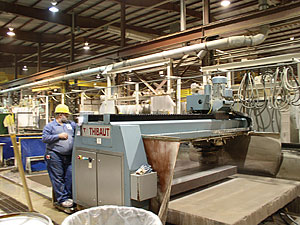
A Thibaut bed polisher from France is used for polishing slabs.
A second building on Cold Spring Granite’s site is Slab Tech, which encompasses 30,000 square feet. The plant is equipped with various diamond wire sawing and stone polishing equipment, including three Pellegrini Stone Master diamond wire saws from Italy, two Sun Jin saws from Korea and a LeviBreton KGS polishing line from Breton of Italy.
To give workers a sense of involvement, the company maintains a “Slabbing Tech Center Scoreboard” in the Slab Tech building. “It gives managers and employees a chance to look at how we are doing,” said Jaeger. “It’s a simple tool that allows employees to see what works and what is not working, and they can fix it.”
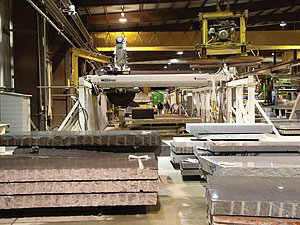
Additionally, a Predator automated gantry block saw
from Park Industries of St. Cloud, MN, is also incorporated into the production
process.
Thin Stone facility
Cold Spring Granite’s “Thin Stone” facility is housed in an approximate 200,000-square-foot building, and is mostly used for material measuring 2 ½ inches and under. The facility houses 12 Barsanti gangsaws, and the gangsaw “Wet Scrubber” is one of many pieces of equipment that purifies the air in the work environment.
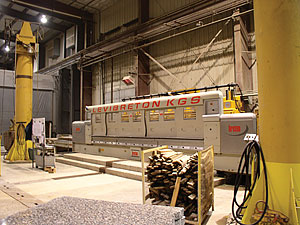
The “Thin Stone” plant houses a LeviBreton KGS
polishing line for polishing slabs.
Striving to be more efficient
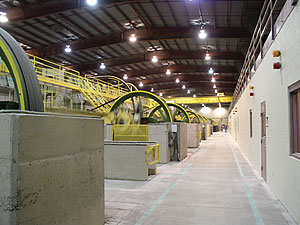
The Thin Stone facility is housed in a
200,000-square-foot building, and it operates 12 Barsanti gangsaws.
Communication was a key part for a successful transition, according to Rea. “We stepped up our communication and explained why we are doing it,” he said. “People are wearing many hats. Flexibility helps us a lot.”
Sidebar: Green features of Cold Spring Granite Co.'s new LEED-certified headquarters'
• 31% reduction in office space from the old facility.• Vegetated open space, planted with prairie grass mix and sod, and is greater than the building footprint.
• Existing imperviousness is greater than 50%, and all stormwater runoff is directed to infiltration ponds and pretreated.
• 77% of the roof incorporates a white aggregate ballast material and white skylight having a Solar Reflectance Index of 105 SRI value (low slope) and 100 SRI value (steep-sloped).
• Light Pollution Reduction - no horizontal or vertical trespass light at 10 feet beyond property line. The power for exterior site lighting is 60% below LEED allowable power. Actual power on exterior building facade/landscape lighting is 23% LEED allowable power.
• Building has a bike rack and shower/changing room to promote alternative transportation. Preferred parking for low-emitting/fuel-efficient vehicles and car/van pool parking is also available.
• Landscaping and irrigation systems have been designed to reduce irrigation water consumption by 82% and the irrigation water used on site is supplied by a non-potable source.
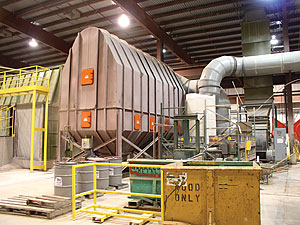
The gangsaw “Wet Scrubber” is one of many pieces of
equipment that purifies the air in the work environment.
Additional Photos
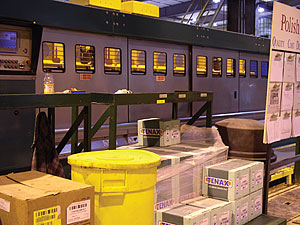
Among other equipment is a 20-year-old Breton
polishing line that uses abrasives from Tenax USA
of Charlotte, NC. “There are many examples of machines
that have gone beyond their expected life-cycle because of our equipment
maintenance program,” said Jaeger.
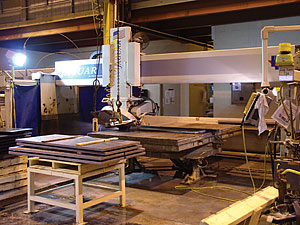
A Jaguar from Park Industries is used to cut slabs.
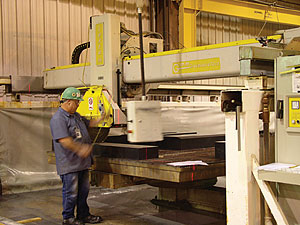
Three GMM Lexta 36 bridge saws from Salem Stone of
Winston-Salem, NC, are also in operation at the Thin Stone plant.
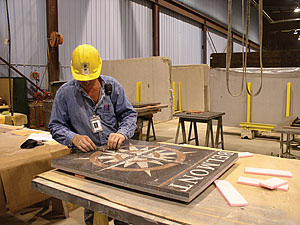
Employees take care in producing custom-made work.
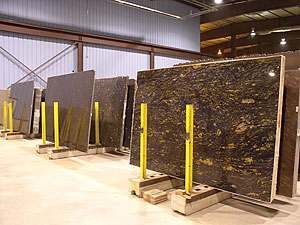
An inside storage area is dedicated to exotic slabs.

Stone for in-progress projects is stored in an outside
yard. “All the stone in the yard is for a specific job,” said Jaeger