Stone World
  Home
  Subscribe
  eNewsletter
  Subscription Customer Service
  Online
  Latest News
  Blog
  Product & Literature Guides 2009
  Products of the Month
  Tools of the Trade Store
  Web Exclusives
  Current Issue
  Features
  Columns
  Industry News
  Products
  Calendar
  Newsline
  Stone World Events
  Education Seminars with MIA
  Resources
  Archives
  Digital Edition Archives
  Fabricator E-News Archives
  Stone Guide/Directory
  Industry Links
  List Rentals
  Career Center
  Market Research
  Monthly Statistics
  Showrooms
  Online Product Focus
  Advertising
  2009 Media Kit
  2010 Media Kit
  Classified Ads
  Digital Edition Advertising
  eNewsletter Advertising
  Contemporary Stone & Tile Design
  SW Info
Search in: EditorialProductsCompanies
Limestone sets standard for future of campus
by Michelle Stinnard
March 12, 2007

ARTICLE TOOLS
EmailEmailPrintPrintReprintsReprintsshareShare

Western Michigan University (WMU) in Kalamazoo, MI, recently opened a 195,000-square-foot, state-of-the-art College of Health and Human Services (CHHS) facility, and Mankato Kasota limestone from Mankato Kasota Stone, Inc. of Mankato, MN, was selected for both interior and exterior elements.
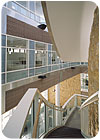
The new 195,000-square-foot, state-of-the-art College of Health and Human Services facility at Western Michigan University features Mankato Kasota limestone throughout portions of its interior and exterior design


According to Project Manager Chris Purdy of SmithGroup, Inc., the brick and Mankato Kasota limestone used in the building were carefully selected to reinforce the College of Health and Human Services goal that the design be warm and inviting.
Western Michigan University (WMU) in Kalamazoo, MI, recently opened a 195,000-square-foot, state-of-the-art College of Health and Human Services (CHHS) facility on its Oakland Drive campus, and SmithGroup, Inc. was hired to carry out the design. The new facility consolidates all WMU Health and Human Services faculty and academic programs into a single learning facility for teaching, research and community-based health and human services activities. Warm cream-colored Mankato Kasota limestone from Mankato Kasota Stone, Inc. of Mankato, MN, was used in a split-faced finish to accent the buildings exterior facade, as well as for interior elements such as columns and walls.

“As CHHS is the first WMU facility on the new campus, it will play a key role in setting the standard for future WMU facilities constructed on this campus,” said Chris Purdy, AIA NCARB, of SmithGroup, Inc., who served as the project manager for the new building. “For this reason, masonry was chosen as the principle exterior material because of its inherent qualities: longevity and monumentality.”

According to the architect, the brick and Mankato Kasota limestone were carefully selected to reinforce the College of Health and Human Services’ goal that the design be warm and inviting. “The brick was chosen because its pattern has frequently recurring yellow hues that relate directly with the yellow and buff colors of the Mankato stone,” he added.

The new CHHS facility is comprised of two main components, including a rectangular bar-shaped building facing westward towards the 120-foot-long mall, and a sweeping arc-shaped building conforming to the easternmost tree line on campus. Both structures extend from a centralized four-story atrium.

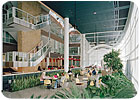
The limestone was used for walls and columns throughout the main atrium of the facility, while Black granite was utilized for horizontal surfaces serving as a border around the space.
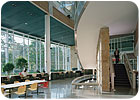


The limestone was used for walls and columns throughout the main atrium of the facility, while Black granite was utilized for horizontal surfaces serving as a border around the space.
“The masonry used in the bar building provides an anchor for the more dynamic and fluid aspects of the design, including the ‘motion lab’, a gymnasium-like space which projects above and cantilevers over the north end of the bar, creating a distinct identifying feature of the college for Campus Mall pedestrians below,” Purdy explained.

“Furthermore, the orthogonal geometry of the bar building forms a strong defined western edge for the new South Campus Mall. The regular geometry of the brick and Mankato stone used in the section of the building help reinforce this edge, while framing distant views of the old water tower to the south. The curvilinear arc section of the building is also visually anchored by the solidity of its masonry counterpart.”

Construction on the facility began in 2003 and lasted approximately two years. The project received an Excellence in Design Award for Higher Education by the Masonry Institute of Michigan in 2006.

“The view of the CHHS facility above the trees as you stand on the main campus provides a significant visual link, integrating the new building and the new Oakland Drive campus within the entire WMU campus fabric,” said Purdy.


Michelle Stinnard
stinnardm@stoneworld.com
Michelle is the assistant editor of Stone World.

|PrintEmail

Did you enjoy this article? Click here to subscribe to the magazine.
BNP Media